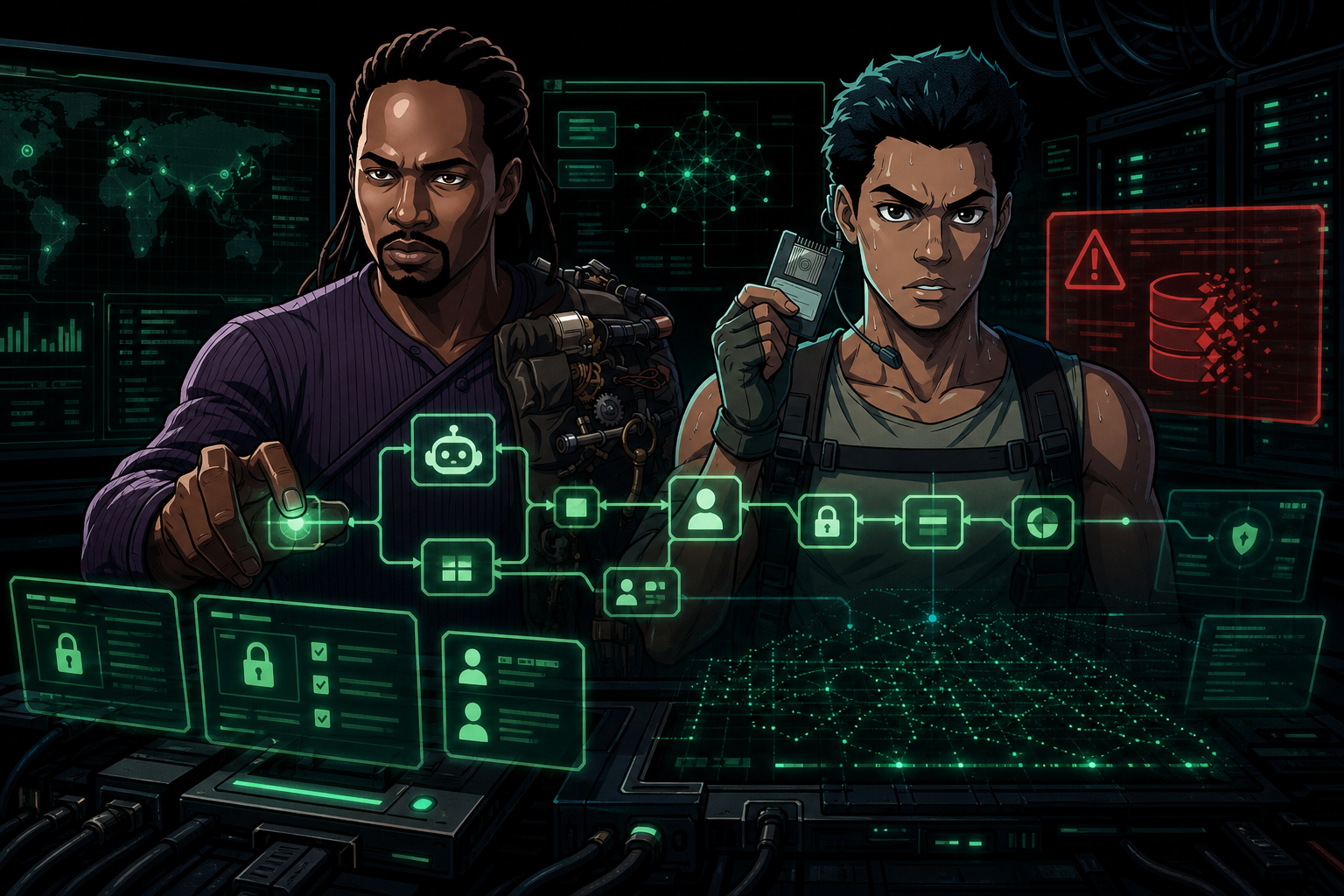
The last 24 hours in AI were not about one magic model, one viral prompt, or one founder claiming they replaced a department with a Notion table and vibes.
The useful signal is simpler and more awkward: AI is getting boring in exactly the way serious technology gets boring before it becomes everywhere.
Agents are becoming infrastructure. Compute is becoming corporate strategy. Design agents are becoming product patterns. The Pentagon is doing vendor selection. Investment firms are buying land for data centres. And somewhere, inevitably, a company has learned that giving Claude enough power to delete a database is a tremendous way to find out whether your backups are real or just spiritually comforting.
That is the shape of the day, and it is the first useful signal for Tank & Link Intelligence.
The useful signal
The market is moving from “look, the model can do a thing” to “how do we safely run this thing every day without burning money, leaking data, or letting it trip over the furniture?”
That matters because most businesses are still stuck in demo-land. They have a ChatGPT subscription, a few internal enthusiasts, and a leadership team saying “we need an AI strategy” with the same energy your uncle brings to buying crypto at Christmas.
The serious operators are asking different questions:
- Who owns the agent workflow?
- What does the agent have permission to touch?
- Where does context live?
- How is work reviewed?
- What happens when the model is wrong?
- What do we automate first so it actually makes money?
That is where the opportunity is now. Not in another wrapper. In the operating system around the wrapper.
1. Agent infrastructure is becoming the product
The AI Daily Brief covered the idea of “harness-as-a-service”: the infrastructure layer around agents. Not just the model, but the harness that lets agents work: context, tools, permissions, memory, monitoring, budget controls, handoffs, and review loops.
This is the bit most teams miss. The model is not the employee. The model is the brain in a jar. The harness is the desk, calendar, manager, filing cabinet, legal department, CCTV, and HR policy.
Without the harness, “AI agent” just means “a probabilistic intern with root access”. Brave. Also stupid.
The same episode also pointed at the big cloud numbers: Google Cloud up heavily year-on-year, Azure still growing, AWS still growing, Meta still throwing off cash. Whether you believe we are in an AI bubble or not, the picks-and-shovels people are currently selling a lot of picks and a disturbing number of shovels.
Why it matters:
For builders and agencies, this is the wedge. Clients do not need another chatbot bolted onto their website like a novelty doorbell. They need agent systems with workflow, permissions, evaluation, and reporting.
The sell is not “we use AI”. The sell is:
“We can safely remove 30% of the recurring manual work from this process, show you exactly what the system did, and keep a human in the loop where judgement matters.”
That is a much better business than prompt-pack theatre.
2. OpenAI is repositioning around compute, distribution, and work
Hard Fork’s latest episode framed OpenAI as being in a strategic reset: Microsoft deal changes, Amazon expansion, Stargate compute strategy, and more pressure to turn gigantic usage into gigantic revenue.
Ignore the soap opera for a second. The Musk trial is entertaining, yes, but it is mostly billionaire theatre with subpoenas. The useful part is the business model pressure.
OpenAI has to solve three things at once:
- Compute supply | more GPUs, more data centres, more energy, more partners.
- Distribution | ChatGPT everywhere, consumer and workplace.
- Monetisation | subscriptions, enterprise, ads, agents, APIs, probably some things nobody will admit to until they work.
This is why the “Codex can use your computer” direction matters. The AI Advantage tested OpenAI’s push toward a professional agent for non-technical knowledge workers: not just a coding assistant, but a computer-using worker that can browse, click, and execute tasks.
The interesting line from the transcript was basically: this is an agent for the 80%, not just developers. ChatGPT with access to your computer, with the ambition that it does work for you rather than merely with you.
Tank & Link view: useful, but do not get drunk on it.
Computer-use agents are going to be huge. They are also going to be a mess. The browser is where modern work happens, which makes browser control incredibly powerful. It also makes it incredibly easy for an agent to click the wrong thing, trust the wrong page, expose the wrong data, or confidently complete the wrong task.
So yes: test it. But do not hand it your Stripe account and go for lunch.
3. Claude Design is not about design. It is about vertical agent patterns.
Sam Witteveen’s breakdown of Claude’s Design Agents was one of the more useful watches because it did not get stuck at “wow, pretty slides”.
The point was that Claude Design shows patterns that can be reused in vertical agent products:
- Context grounding before generation
- A source of truth such as a design system
- Iterative creation rather than one-shot prompting
- Tool handoffs
- Export paths into real workflows
- A more constrained experience than a blank chat box
This matters a lot for anyone building client-facing AI products.
The dumb version of AI product design is: blank text box, “ask me anything”, pray.
The better version is: give the agent a defined job, a source of truth, a small number of safe tools, a visible workflow, and a clear output format.
That is why design systems, templates, schemas, and process maps suddenly matter more, not less. The better your operating context, the less your agent behaves like a clever drunk.
For agencies, this is particularly relevant. Most client value will not come from raw model intelligence. It will come from packaging intelligence into a workflow the client can understand, trust, and repeat.
4. Small teams are getting weirdly large leverage
PulumiTV’s “How AI Agents Turned 5 Engineers Into 50” is obviously a punchy title, but the useful bit is not the exact multiplier. It is the operating lesson.
The guest described agents writing code, including infrastructure, and getting from signed contract to custom code running in customer cloud accounts in a day or two.
That is the correct direction of travel: not “replace engineers”, but compress the dead time between decision and working software.
The important line from the transcript was that you cannot just treat agents as another incremental tool inside the old workflow and expect the full benefit. If you put agents into a slow organisation, they mostly become fast creatures trapped in treacle.
Practical translation:
If a business wants serious AI leverage, it has to redesign the workflow around the agent. Otherwise it gets the worst version of everything: extra tools, extra meetings, extra risk, and no actual speed.
This is where AI agencies should be making money. Not by selling “custom GPTs”, but by rebuilding the process:
- intake
- context gathering
- execution
- review
- client approval
- deployment
- reporting
That is the agency opportunity. The winners will sell operating leverage, not magic.
5. The Pentagon is picking AI suppliers now
WSJ Tech News Briefing reported that the US Defense Department has completed agreements with seven tech companies for AI capabilities in classified settings: OpenAI, Google, Microsoft, Amazon, Nvidia, SpaceX, and Reflection AI.
The notable bit: Anthropic was not included in this round, after rejecting a defence contract earlier in the year according to the WSJ segment. The Pentagon also appears to want more customisable/open-source-style options, not just closed frontier models.
This is not a moral endorsement. It is a market signal.
AI has moved from productivity toy to national infrastructure. Government buyers want access, customisation, security posture, and supplier diversity. That tells you where enterprise AI is going too.
Businesses will not standardise on one magic model. They will want a portfolio:
- closed models for capability
- open models for control
- private deployments for sensitive work
- specialist agents for vertical tasks
- audit trails so somebody can explain what happened when the machine does something stupid
Again: infrastructure, not demos.
6. Data centres are now the physical layer of the AI race
Another WSJ Tech News Briefing item reported that Coatue is launching a venture to buy land for AI data centres, with tens of billions potentially going into the effort.
That is not a small footnote. That is the physical shape of the AI economy.
Everyone talks about models. The real bottlenecks are increasingly:
- land
- power
- chips
- cooling
- interconnects
- regulation
- grid capacity
- capital
The AI race is not just happening in Python notebooks. It is happening in planning permission, energy markets, and boring infrastructure spreadsheets. Glamorous? No. Important? Very.
For founders, this means two things:
- Do not assume inference will always get magically cheaper for your use case.
- Build products where the value created is much higher than the compute burned.
If your AI product needs £3 of model calls to produce £2 of value, you have not built a business. You have built a very well-lit bin fire.
7. Open models keep creeping up
Matt Wolfe’s round-up pointed at DeepSeek V4, open models, long context windows, and Nvidia’s local/agent-focused model work. The exact leaderboard positions will change by the time you finish your coffee, but the direction is clear: open-weight and local-capable models keep getting less embarrassing.
That matters because the future stack is not “one frontier model to rule them all”. It is routing.
Use the expensive frontier model where judgement and reasoning matter. Use cheaper or local models where speed, privacy, or cost matter. Use specialist tools where deterministic software beats stochastic word soup.
The smart stack is mixed. The lazy stack sends everything to the most expensive model and then wonders why the margin looks like a crime scene.
What is actually useful from today?
Here is the operator-grade signal:
Useful now
- Build agent workflows around permissions, context, logging, and review.
- Use design systems and source-of-truth docs to ground creative/design agents.
- Test computer-use agents, but only in sandboxed, low-risk workflows first.
- Watch the compute market because it will affect pricing, availability, and product margins.
- Treat open models as part of the stack, not a religion.
Worth watching
- OpenAI’s move from chat product to work execution layer.
- Claude-style vertical agents as a pattern for SaaS products.
- Defence/government AI procurement as a preview of enterprise buying behaviour.
- Data centre land/power plays as the unsexy but decisive AI infrastructure layer.
Ignore for now
- “Everyone will be replaced by Friday” posts.
- Screenshot entrepreneurs claiming their AI workforce did £10m of labour overnight.
- Any agent demo with no mention of permissions, evaluation, rollback, or failure modes.
- Model leaderboard panic unless you are actually choosing infrastructure today.
Practical takeaways
If you run a business, pick one workflow and instrument it. Do not “do AI”. Choose a process with repetitive work, clear inputs, clear outputs, and annoying manual steps. Then build an agent-assisted version with logs and review.
If you build AI products, stop shipping blank chat boxes. Package the agent into a job. Give it context, constraints, tools, and a finished output.
If you are an agency, sell the harness. Clients do not know they need it yet, but they do. The model is easy to buy. The safe operating layer is the value.
If you are using computer-control agents, start boring. Let them research, summarise, draft, organise, and check. Do not let them delete, spend, publish, email clients, or mutate production data without guardrails.
If you are thinking about AI margins, measure compute cost per useful outcome. Tokens are not free. Human review is not free. Failed automation is definitely not free.
Tools, repos, or links mentioned
- AI Daily Brief | harness-as-a-service / agent infrastructure: https://www.youtube.com/watch?v=jvqQ8VlhO-w
- Sam Witteveen | Claude Design Agent patterns: https://www.youtube.com/watch?v=V-djAkt0t-M
- The AI Advantage | OpenAI Codex computer-use testing: https://www.youtube.com/watch?v=t7l2XkgkyxE
- PulumiTV | agents in engineering workflows: https://www.youtube.com/watch?v=oHNdlWlsR-w
- Hard Fork | OpenAI strategy reset: https://www.youtube.com/watch?v=3khLoSNCjWw
- Matt Wolfe | weekly AI news round-up: https://www.youtube.com/watch?v=qDI4odijz44
- WSJ Tech News Briefing | Pentagon AI deals and AI data-centre land grab: https://www.wsj.com/podcasts/tech-news-briefing
Tank & Link view
The hype cycle is trying to convince everyone that the next step is “autonomous companies”. Maybe eventually. But today’s useful work is much less sexy: permissions, context, memory, audit logs, evals, handoffs, and productised workflows.
That is good news if you are an operator. Boring infrastructure is where the money hides.
The winners are not going to be the people who shout “agents” the loudest. They will be the people who can point at a workflow and say:
“This used to take two people three days. Now it takes one person ninety minutes, and here is the audit trail.”
That is the whole game.
Everything else is conference fog and LinkedIn jazz hands.